
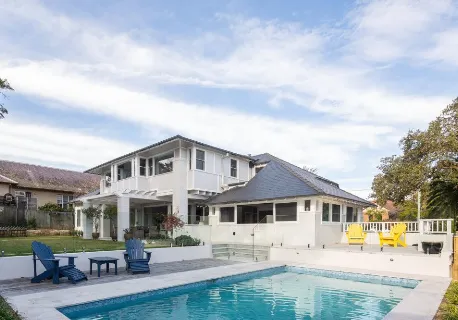
Freshwater
Concept: Creating a light, airy, character-filled three-level Hampton-style beach home on a small corner site

The intention of senior living homes and facilities is to provide spaces that support seniors’ lifestyle and life stage and encourage personal and community health and wellness. They must also be places that the aged can still call home.
There are specific architectural considerations to make when designing housing for the aged from legislative, council and design perspectives.
Around 16.2% of Australians are aged 65 and over. The NSW Government made planning provisions for senior housing through the State Environmental Planning Policy (Housing) 2021 (SEPP).
According to the State Government’s website, the policy ensures that seniors’ housing meets industry standards and community expectations.

It defines senior living criteria, including areas where senior housing can be developed, the age seniors are eligible for senior housing (60), parameters for the internal and external living and communal spaces and residential zones where senior housing may be established.
For some sites on the North Shore and Northern Beaches area, strict bushfire evacuation risk parameters are also in place that are in bushfire zones and/or biodiversity-zoned land areas. SEPP Seniors are generally excluded from these sites and/or development is restricted.

The program gives developers an incentive that overrides some local planning restrictions to construct suitable dwellings that meet particular criteria.
Access to local amenities and adequate safety measures are some of these criteria. Our architects at Playoust Churcher place comfort and convenience at the top of the list too.
The SEPP Seniors Code makes it possible to build 2-storey medium-density style residences in areas that permit detached houses only.
It also makes it possible to build single level villa style townhouses or units land zoned for urban purposes (provided the original block is larger than 1000 square metres), has a frontage of 20m or more and is within 400m of public transport.

Designing for the aged requires a unique approach.
“A house must feel like a home,” says our MD, Brett Churcher.
“Its really no different designing a SEPP Seniors home to designing a new home for a younger family, in that the principles of living – being good passive solar design, flow of internal spaces to the outside, the ability to entertain extended family etc., remain the same”.
Senior housing dwellings are designed to support everyday living, provide comfort and boost a sense of community. They need to be designed in a way that can deliver physical and emotional support to seniors and people living with a disability.

Sustainability, open-plan living with ample space, sloped floors instead of stairs and walk-in showers with no hob are some design considerations when designing senior housing.
“We place a large focus on the indoor/outdoor relationship and make sure there is a good flow between the modern kitchen, meals and living spaces. An outdoor, covered courtyard or terrace is also important when designing senior housing.”
We are the experts on Sydney SEPP Seniors living. We can look at any block of land and assess the feasibility of a project by determining the highest and best use. And we have decades of design experience to create a bespoke boutique development that will deliver you a solid return. So, if you’re a developer looking for a solid return, contact us to start the conversation.
It refers to designing homes with accessibility, adaptability, and long-term comfort in mind—such as step-free access, wide corridors, non-slip flooring, accessible bathrooms, and flexible zones to support mobility changes over time.
With an ageing population, planning ahead allows homeowners to remain independent and comfortable in familiar surroundings longer. Thoughtful design also improves safety, resale appeal, and overall liveability.
Key strategies include entry-level living, accessible bathrooms and kitchens, universal corridors, flexible floorplans, clear circulation, and integration of assistive planning (like grabrails, ramps, or future lift zones).
Yes. Subtle interventions—such as threshold ramps, wider doorways, or reconfigured layouts—can greatly improve accessibility while preserving heritage character and respecting council controls.
We begin with lifestyle and feasibility evaluations, then develop concepts that balance accessibility with aesthetic quality. Our designs focus on adaptability, comfort, and compliance while working within site and heritage overlays.
Depending on location, councils may require compliance with accessibility or bushfire protection standards. We integrate consultant coordination (e.g., accessibility, structural, planning) from early design stages to minimize delays.
Start with a feasibility and lifestyle consultation. We’ll assess your site, goals, and design preferences, then propose age-adapted home strategies that support safety, comfort, longevity, and compliance.

The goal of senior housing isn’t just functional—it’s about creating spaces that support the holistic lifestyle of older adults, promoting both personal well-being and community connection. Homes need to feel like homes.
Early integration of senior-living principles—like accessible layouts, longevity in material choices, and flexible zoning—ensures both savings and long-term usability. Future-proofing can make a substantial difference in both cost and comfort.
In areas subject to bushfire or environmental overlays—common in the North Shore and Northern Beaches—SEPP Seniors developments often face limitations.
Designing for seniors doesn’t change the essence of good architecture. Key principles—passive solar design, smooth indoor-outdoor flow, and family-oriented entertaining—remain central.
Managing Director & Nominated Architect
NSW Architect Registration No. 5924
With over 30 years of architectural experience, Brett Churcher leads Playoust Churcher Architects with a rare combination of design expertise and commercial insight. As a registered architect and Managing Director, Brett has played a pivotal role in delivering high-end single residential homes and boutique medium-density developments across Sydney’s North Shore and beyond.
Brett’s unique strength lies in his deep understanding of both architectural design and the Sydney property market. His valuation background enables him to align creative vision with practical feasibility, ensuring each project achieves both aesthetic excellence and financial viability.
At Playoust Churcher, Brett drives the studio’s growth, strategy, and leadership, while remaining closely connected to what matters most: the client. His ability to see the bigger picture from a client’s perspective and to guide projects seamlessly through the design process is at the heart of his role and reputation.

Reach out to Brett to explore how Playoust Churcher can bring it to life—with clarity, creativity and confidence.

Concept: Creating a light, airy, character-filled three-level Hampton-style beach home on a small corner site
Concept: Adapting a beautiful family heritage home in a quiet street on a large site to suit the family’s lifestyle

Concept: Designing a new family home that maximises the views and introduces a sense of open space

Concept: A complex yet successful renovation of this stunning heritage home in a conservation area

Concept: A 1970s build transformed into a bright, open design maximising stunning harbour views

Concept: A complete rebuild of half the property over two levels, whilst also incorporating the property next door

Concept: A majestic holiday home that pushes the design envelop, blending sustainable materials and natural light


Concept: A major ground floor renovation of a large estate with a new three-car garage and 14 metre pool

© Copyright Playoust Churcher 2026 All rights reserved. Website by Brilliant Digital.
We live and work on the lands of the Gadigal people of the Eora nation. We acknowledge their traditional custodianship of the land and pay respects to their Elders past, present and emerging.