
Freshwater
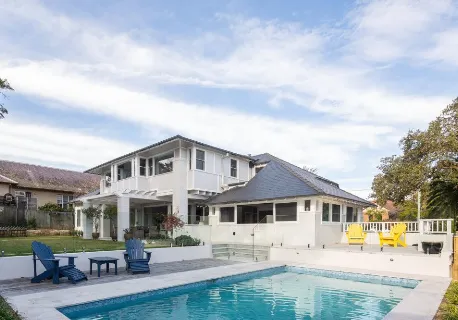
Concept: Creating a light, airy, character-filled three-level Hampton-style beach home on a small corner site

Flexibility and adaptability are traits that any great architect must possess, especially when it comes to a renovation project of a home that is representative of a significant era in our history.
Interwar bungalow style means exactly that – bungalow style homes built in Australia between the two World Wars.
In the early to mid 1900s, this became a hugely popular style of home, and examples can be found throughout Sydney’s North Shore suburbs.
Our approach to renovating these style homes is to pay respects to their original charm while adding modern functionality.

Free standing bungalow homes came to prominence in Australia by way of designs popularised in California.
Features that characterise these houses include sloping walls, dark coloured bricks, triangular roofs, stained glass windows, a front verandah, timber flooring, bay windows, large overhangs, small entrances that open up inside, ornate cornices, high ceilings and architraves around windows and doors. Some include elements of Art Deco styling, such as curved walls and windows.
With heavy influence from America, bungalow style homes caught on rapidly. They became so popular in Australia that it was to become the commonest house form in the inter-war period.

According to Playoust Churcher architect Brett Churcher, the location of these homes in older areas adds to their desirability and value.
Prior to the inter-war period, people tended to live in close proximity to rail lines. As vehicles became more prominent, people on Sydney’s North Shore moved further north and could acquire larger blocks of land. These larger sites appeal to buyers to this day.
“What also appeals to people are the specific period features such as the large proportions of the rooms, high ceilings, beautiful timber work and general aesthetic details. The window opening proportions were well scaled and pleasing to the eye,” says Brett.
In fact, the entire house is well scaled, which makes the entire building look… just right.
Its vertical proportions were also due to restricted options in building techniques. Spanning large distances was expensive for residential construction, therefore space was achieved via height.
This opens up a whole world of possibilities in bringing together the ‘old’ and the ‘new’ in interwar bungalow style homes.

Brett and the Playoust Churcher team have undertaken renovation projects on many interwar bungalow style homes on the North Shore.
Many people fall in love with the charm of the old design styles, but they want more space and need a house that is more suitable for a modern lifestyle.
From a heritage perspective, changes to the facade of interwar bungalow style homes are fairly restricted. This gives homeowners two main choices: are they going to add modern touches to the interior of the home, but keep the original style intact, giving the whole home a heritage feel, or do they want to create a split between old and new by incorporating open, contemporary spaces at the back of the house?
“It can be really tricky to find the sweet spot between what we’re allowed to do from a council perspective and meeting the client’s needs,” says Brett, which is why flexibility and adaptability are two key traits needed from the architect.
In these modern days, we are able to create larger spans and open spaces. One way to deal with the renovation process is to create a transition zone which links the traditional style to a more contemporary open style at the back.
“Most of our clients want to create more spacious areas at the back with modern touches, while still paying respects to the original design style of the house. In these cases, we create a softer transition from the front towards the rear,” explains Brett.
This means the renovated house would keep elements such as decorative cornices, timber flooring and windows and high ceilings.

In heritage conservation areas, the rules are often strict regarding what can and cannot be demolished. And these rules can be quite particular, too. For example, in some cases the walls and roof lines must remain intact, while certain interior features are allowed to be demolished.
This is where you need an architect by your side who is well versed in DA processes and who can take care of the administration surrounding the planned renovation project.
Furthermore, it takes great skill and years of experience in heritage renovations to provide a council approved home design that is suitable for your lifestyle.
At Playoust Churcher, we have the know-how to navigate the often complex DA processes and our skills are flexible to work around any restrictions that may arise.
Talk to us about your interwar bungalow style renovation project – we’d be more than happy to help.
Interwar bungalows typically date from the 1920s to 1940s. They are modestly sized with hipped or gabled roofs, wide verandahs, detailed timber joinery, and Edwardian or California Bungalow influences. Areas like Lindfield, Killara, Wahroonga, and Mosman commonly feature this heritage type
Yes. Thoughtful renovations can preserve façade symmetry or timber details while reconfiguring interiors to introduce open-plan living, improved light, better insulation, and indoor-outdoor connections. The aim is to balance heritage charm with contemporary good design.
Often. Many northern suburbs fall under Ku‑ring‑gai or Willoughby Council conservation overlays. This means changes to roof lines, materials, façade design, or fenestration may trigger council approval. We manage heritage impact assessments and submissions to secure approval.
Renovations typically include open-plan kitchen and living spaces, upgraded bathrooms, improved natural light, internal insulation, enhanced outdoor areas, and modern finishes—all delivered with sensitive consideration for existing architecture.
Absolutely. We specialise in heritage-sensitive design across northern suburbs—such as Turramurra, Lindfield, Killara, Roseville, and Wahroonga. From feasibility to DA approvals and construction coordination, we guide the entire renovation process.

Interwar bungalow homes are especially coveted across Sydney’s North Shore owing to their generous room proportions, soaring ceilings, elegant timber work, and proximity to established rail networks—making them both historically.
The firm’s approach intentionally retains the original charm of these homes—such as ornate cornices, bay windows, verandahs, and stained glass—while embracing contemporary needs through well-considered extensions or layout adjustments.
Recognising that modern lifestyles demand openness, Playoust Churcher employs subtle transition zones between traditional and contemporary parts of the home—softening the shift from heritage to modern additions.
Playoust Churcher’s experience with heritage home renovation goes beyond design—it includes decisive strategies, compliance oversight, and client collaboration to ensure both emotional and regulatory needs are met.
Managing Director & Nominated Architect
NSW Architect Registration No. 5924
With over 30 years of architectural experience, Brett Churcher leads Playoust Churcher Architects with a rare combination of design expertise and commercial insight. As a registered architect and Managing Director, Brett has played a pivotal role in delivering high-end single residential homes and boutique medium-density developments across Sydney’s North Shore and beyond.
Brett’s unique strength lies in his deep understanding of both architectural design and the Sydney property market. His valuation background enables him to align creative vision with practical feasibility, ensuring each project achieves both aesthetic excellence and financial viability.
At Playoust Churcher, Brett drives the studio’s growth, strategy, and leadership, while remaining closely connected to what matters most: the client. His ability to see the bigger picture from a client’s perspective and to guide projects seamlessly through the design process is at the heart of his role and reputation.

Reach out to Brett to explore how Playoust Churcher can bring it to life—with clarity, creativity and confidence.

Concept: Creating a light, airy, character-filled three-level Hampton-style beach home on a small corner site
Concept: Adapting a beautiful family heritage home in a quiet street on a large site to suit the family’s lifestyle

Concept: Designing a new family home that maximises the views and introduces a sense of open space

Concept: A complex yet successful renovation of this stunning heritage home in a conservation area

Concept: A 1970s build transformed into a bright, open design maximising stunning harbour views

Concept: A complete rebuild of half the property over two levels, whilst also incorporating the property next door

Concept: A majestic holiday home that pushes the design envelop, blending sustainable materials and natural light


Concept: A major ground floor renovation of a large estate with a new three-car garage and 14 metre pool

© Copyright Playoust Churcher 2026 All rights reserved. Website by Brilliant Digital.
We live and work on the lands of the Gadigal people of the Eora nation. We acknowledge their traditional custodianship of the land and pay respects to their Elders past, present and emerging.